Setting up a nail suite in Texas requires more than buying equipment and hanging a sign. You need two separate TDLR licenses, a source capture ventilation system that meets International Mechanical Code (IMC) Section 502.20 standards, and a sterilization-grade equipment list that hair suites simply do not require. The chemical load from acrylic monomer, acetone, and gel polish products demands a level of ventilation infrastructure that general HVAC cannot satisfy. On the licensing side, most nail techs transitioning from a commission salon know they need their individual Manicurist license but the Cosmetology Mini-Salon Establishment License catches nearly everyone off guard. The most common nail suite setup mistake is operating without that second license.
A nail suite setup in Lewisville is defined by three non-negotiables: a 50-CFM source capture exhaust system at every nail workstation, a TDLR Cosmetology Mini-Salon Establishment License in addition to your individual Manicurist license, and a manicure table with a built-in ventilation port. Equipment categories for a nail establishment include a manicure table, pedicure chair (almost always plumbless in a suite rental), UV/LED curing lamp, autoclave or dry heat sterilizer, EPA-registered disinfectant containers, and adequate task lighting with lockable storage for flammable chemicals. From decision to first paying client, expect a realistic timeline of 4 to 8 weeks, with TDLR processing of the Mini-Salon license being the most common bottleneck.
A nail technician who confirms ventilation compliance and license coverage before signing a lease avoids the retrofit costs and regulatory exposure that follow a non-compliant move-in.
Start with ventilation. Ask the suite provider directly: does the nail suite have a source capture exhaust system wired to outdoor air, separate from the building’s general HVAC? Source capture pulls chemical fumes at the nail workstation, which is what IMC Section 502.20 requires for nail establishments. A suite with only standard HVAC does not meet IMC code for nail services. If the existing ventilation is not compliant, find out whether ductwork can be added and who is responsible for the cost. The nail technician bears the compliance risk, not the building owner.
Next, ask about pedicure drain access. A suite without a floor drain rules out a plumbed pedicure chair entirely. Confirm this before ordering equipment, because the wrong choice is expensive to undo.
Review the lease for modification restrictions. Most salon suite leases prohibit permanent changes to walls, plumbing, and electrical. That affects how ventilation ducting runs and whether you can add outlets for nail equipment.
Finally, the establishment license. Texas treats each enclosed suite as its own establishment, so each suite renter must obtain their own TDLR Cosmetology Mini-Salon Establishment License, separate from their individual Manicurist license.
A nail suite requires a different equipment mix than a hair suite. Sterilization tools, source capture ventilation components, and a pedicure chair decision that hinges on plumbing access are the distinguishing factors. Here is what goes in each category.
Practical Note: Pedicure Chair Selection
Most salon suite leases prohibit permanent plumbing modifications, which makes a plumbed pedicure chair impractical for suite renters regardless of preference. A plumbless chair with a removable, manually filled basin is the standard choice: no permits, no landlord negotiation, and simpler sanitation. Confirm whether your suite has floor drain access before ordering any pedicure chair.
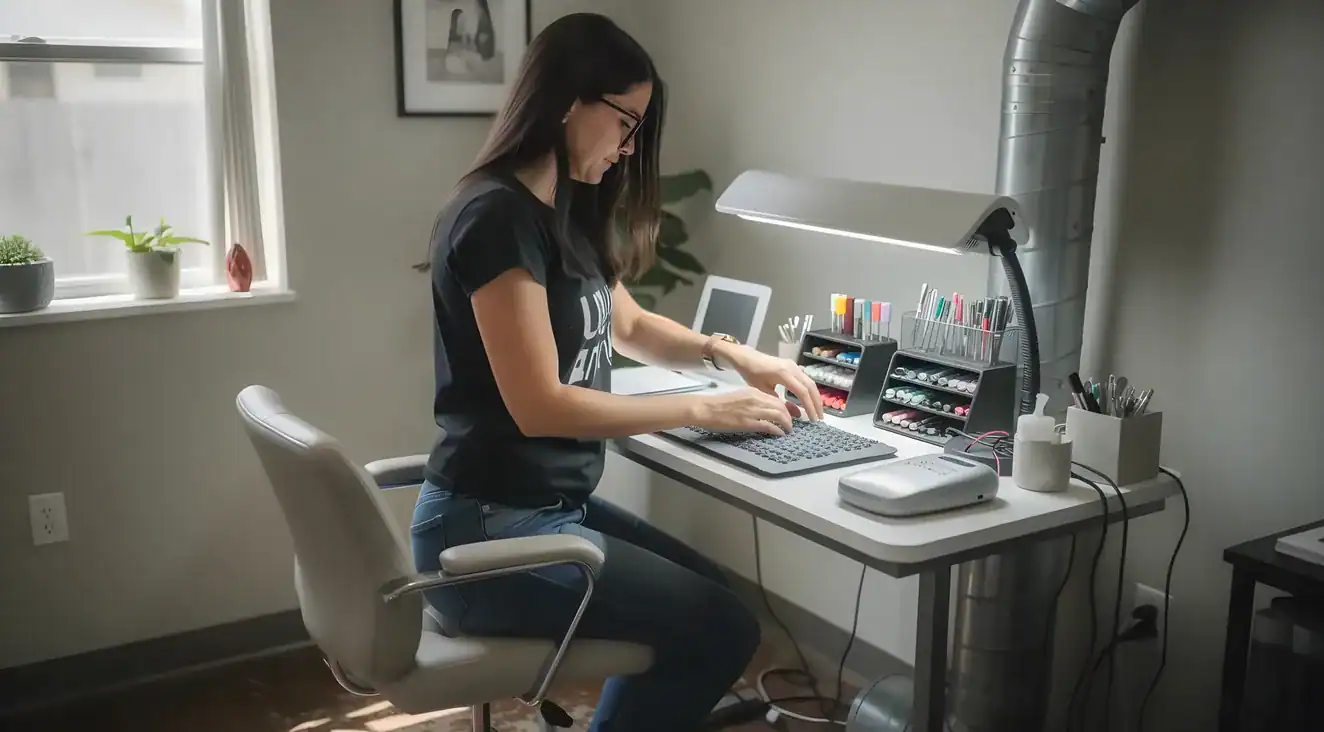
The manicure table is the center of a nail suite setup, and the ventilation port spec matters most. Choose a table with a built-in 4-inch ventilation port where the source capture duct connects. Retrofitting source capture onto a table without a port is less effective and structurally awkward. Buy the right manicure table first.
TDLR requires all nail establishment work surfaces to be non-porous, which rules out unsealed wood or fabric finishes. The client chair sits opposite the nail technician; the technician stool should be ergonomically adjustable with lumbar support. Nail work at the wrong height over a long shift causes repetitive strain injury, and adjustable seating is a practical necessity at this volume, not a luxury.
For UV/LED curing, a dual-wavelength lamp covering both 365nm and 405nm provides the widest gel system compatibility. Wavelength and irradiance matter more than listed wattage.
An electric nail file (e-file) is useful for acrylic and gel removal. Variable RPM control and a balanced-torque handpiece reduce hand fatigue across a full booking day.
Sterilization is where nail techs make a costly setup mistake. TDLR requires either an autoclave, dry heat sterilizer, or UV sanitizer for all reusable metal implements: nippers, scissors, metal pushers, drill bits, and nail clippers. Disinfectant solution does not meet the TDLR sterilization standard. A UV sanitizer cabinet stores already-sterilized tools but cannot sterilize on its own. It maintains sterility; it does not create it. The autoclave or dry heat sterilizer is required. Wet disinfectant containers (at least one per nail station) hold cleaned implements before sterilization.
This decision comes down to one question: does the nail suite have floor drain access?
A plumbed pedicure chair connects to a water supply line and a floor drain. It suits high-volume pedicure work but installation typically requires plumbing work, a permit, and landlord approval that most suite lease agreements do not allow. If the suite lacks a floor drain, a plumbed chair is not an option.
A plumbless pedicure chair uses a basin that fills and drains manually. No plumbing work, no permit, no landlord negotiation. The removable basin simplifies sanitation: it eliminates the whirlpool jet contamination concerns that have historically driven the most cited pedicure-related health violations in Texas nail establishments. Pipeless chairs are a subcategory with motor-driven jets that still require manual filling and draining.
Here is the practical breakdown:
| Plumbed Chair | Plumbless Chair | |
|---|---|---|
| Floor drain required | Yes | No |
| Installation cost | Typically several hundred to a few thousand dollars | None |
| Permit required | Usually yes | No |
| Suite lease compatibility | Often prohibited | Suitable for most leases |
| Sanitation complexity | Higher (jet contamination risk) | Lower (removable basin) |
| Best for | High-volume, purpose-built spaces | Suite rentals |
Confirm drain access before ordering a pedicure chair. Discovering there is no drain after delivery is a costly problem.
Nail technicians carry substantial product inventory: polishes, gels, acrylic powder, acrylic monomer, primers, acetone, nail art supplies, and multiple remover types. Without organized storage, a nail suite deteriorates quickly into a cluttered workspace. A lockable cabinet handles both organization and a safety requirement: acetone, monomer, and polish removers are flammable liquids that must be kept away from heat sources and not stored in unventilated spaces. OSHA’s flammable liquid storage guidance applies to commercial nail spaces. A single-operator nail suite stays well within any storage threshold, but correct practices still matter.
A rotating polish rack keeps color inventory accessible without cluttering the nail desk surface. Single-use disposables need a dedicated, reachable spot protected from cross-contamination.
A dedicated task lamp at the nail desk, at approximately 5000K color temperature with a CRI of 90 or higher, is the lighting specification most nail suite setups skip. The omission shows in color matching accuracy and technician eye strain over a full booking day.
Before committing to an equipment order, you may want to see how the suite is physically laid out. The nail suites in Lewisville are available to tour, and the configuration often informs which equipment fits and how the ventilation duct runs.
Texas nail suites have stricter ventilation requirements than any other beauty service space. The reason is chemical exposure. Acrylic nail services involve ethyl methacrylate (EMA) monomer, a compound that causes occupational asthma and respiratory sensitization at sustained exposure levels. Add acetone vapors, butyl acetate from polishes, and acetonitrile from some adhesive removers, and the resulting chemical fume environment in an enclosed suite cannot be adequately diluted by general HVAC.
IMC Section 502.20 at a Glance
Exhaust Rate
Minimum 50 CFM per nail station via a source capture system.
Inlet Position
Exhaust inlet must be within 12 inches of the nail desk surface (the point of chemical application).
Air Destination
Air must be exhausted to the outdoors. Recirculation does not satisfy the code.
A portable HEPA or carbon filter adds protection but does not satisfy IMC 502.20 source capture requirements on its own. Confirm compliant ductwork before you sign a lease.
IMC Section 502.20 sets the enforceable ventilation standard for nail salons in Texas. Most Texas municipalities have adopted the International Mechanical Code as part of their building code. The specific requirements are:
Source capture ventilation differs from general ventilation in a fundamental way: general HVAC dilutes the whole room, while source capture pulls chemical fumes at the point of generation before they spread through the enclosed suite. For nail services, source capture is the code requirement, not a supplemental recommendation. A portable HEPA or carbon filter unit adds protection but does not satisfy IMC 502.20 source capture requirements on its own.
For nail suite renters in Lewisville, the practical implication is this: confirm whether the suite’s ventilation meets IMC Section 502.20 before signing. If the suite’s exhaust system is not compliant, retrofitting ductwork after move-in requires landlord cooperation and often structural work. Asking before signing creates room to negotiate. Learning about the gap after move-in removes that option.
Of all nail services, acrylic application produces the most concentrated chemical fume environment in an enclosed space. A nail technician planning to offer acrylic work in a private suite needs functional source capture ventilation as the most critical infrastructure item in the setup.
A nail technician who has been working in a commission salon needed only an individual Manicurist license because the salon owner held the establishment license. That changes when renting an independent suite.
Heads Up: You Need Two TDLR Licenses
Most nail techs transitioning from a commission salon only know about their individual Manicurist license. In Texas, running an independent suite also requires a separate Cosmetology Mini-Salon Establishment License ($70, applied at tdlr.texas.gov).
Operating without the establishment license is a citable violation. Inspectors arrive unannounced. Apply for the Mini-Salon license before or on the day you sign your lease, not after you have already started seeing clients.
License 1: TDLR Individual Manicurist License
The TDLR Manicurist license belongs to the nail technician as an individual, not to a business entity. It requires 600 hours at a TDLR-licensed cosmetology school and passing both written and practical state board exams. The application fee is $50 (non-refundable) and is submitted at tdlr.texas.gov. The license is valid for two years, must be renewed, and must be displayed at or near the workstation with a current photo. Inspectors verify this on unannounced visits.
License 2: TDLR Cosmetology Mini-Salon Establishment License
The Cosmetology Mini-Salon Establishment License is the license most nail techs do not know about until they are already operating without it. Any nail technician running an independent business inside a salon gallery (including a private suite) must hold a Mini-Salon Establishment License for that space in addition to the individual Manicurist license.
TDLR defines a Mini-Salon as a room or suite inside a salon gallery that is enclosed with walls and leased by an independent operator to provide cosmetology services. The application fee is $70, applied for at tdlr.texas.gov. Running a nail suite without the Mini-Salon Establishment License is a citable infraction under TDLR’s enforcement authority. Inspectors arrive unannounced and fines are not waived for first-time violations.
At Venus Salon Suites Lewisville, each suite renter is responsible for obtaining their own Cosmetology Mini-Salon Establishment License. Apply for it before booking your first client.
Required Signage (inspectors verify all of these on unannounced visits):
Continuing Education Update (Effective September 1, 2025):
TDLR restructured CE requirements for cosmetology license renewals. Human trafficking awareness is now a mandatory renewal topic for all license holders, regardless of tenure.
If your renewal is coming up, confirm your CE hours include the human trafficking awareness requirement.
Use this before booking anyone into the nail suite. These are the items TDLR inspectors look for and the gaps that trip up first-time suite renters in Texas.
Licensing (complete before booking clients)
Physical Setup
Compliance Display (posted before any client enters the suite)
Consumables Stocked (minimum to open)
Q: Do I need a separate license to rent a nail salon suite in Texas?
A: Yes, and you need two. Your individual TDLR Manicurist license authorizes you to practice nail services but does not authorize you to operate an independent nail establishment. For that, a TDLR Cosmetology Mini-Salon Establishment License is also required: a separate $70 application tied to your specific suite location. Operating without the establishment license is a citable TDLR violation, and fines apply. Apply for the Mini-Salon Establishment License before or immediately after signing your lease. TDLR processing takes time, and this license is the most common reason nail techs are not open as quickly as they planned.
Q: What ventilation does a nail suite need in Texas?
A: International Mechanical Code Section 502.20 requires source capture ventilation at a minimum of 50 CFM per nail station, with the exhaust inlet positioned within 12 inches of the nail desk surface. The air must be exhausted to the outdoors, not recirculated. Before signing a lease, ask specifically whether the suite’s exhaust system meets this standard. If the suite has only general HVAC, it does not meet IMC Section 502.20 for nail services. Adding compliant source capture ductwork after move-in is significantly more complicated than confirming compliance before you sign.
Q: Can I offer acrylic nail services in a private suite?
A: Yes. A private suite is a practical environment for acrylic services, and many nail techs choose it specifically for the environmental control. The critical requirement is ventilation. Acrylic services using ethyl methacrylate (EMA) monomer generate the highest chemical fume load of any nail service. In an enclosed suite, acrylic monomer concentration builds faster than it does on an open salon floor. Source capture ventilation meeting IMC Section 502.20 is not optional for acrylic work. Confirm source capture compliance before booking acrylic clients.
Q: What is a plumbless pedicure chair, and can I use one in a salon suite?
A: A plumbless pedicure chair is a chair where the basin fills and empties manually, with no connection to the building’s water supply or drain. It is the standard choice for salon suite renters precisely because it requires no plumbing installation, no permit, and no landlord approval. Most suite leases prohibit plumbing modifications, making a plumbed chair impractical regardless. An additional practical advantage: disposable basin liners are available for most plumbless models. A liner slips into the basin before each client and is discarded after service, eliminating the need to disinfect the basin interior between clients and serving as a hygiene feature clients notice.
Q: How long does it take to set up a nail suite before seeing the first client?
A: For a nail technician who already holds an active Manicurist license, expect 4 to 8 weeks from decision to first paying client. Getting the Mini-Salon Establishment License processed is where most of that time goes. TDLR typically processes Mini-Salon Establishment License applications within 2 to 4 weeks; apply before or on the day you sign your lease. Equipment lead times add additional days, especially for pedicure chairs, which can take 1 to 4 weeks to ship depending on the model. The rest of the nail suite setup can happen in parallel while you wait on the license.
The suites at Venus are configured for nail services from the start, not adapted from a generic hair suite layout. If you want to see the physical space before committing to an equipment order, a tour is the most practical next step. Seeing how the suite is laid out answers questions that specifications alone cannot: how the ventilation duct runs, where the pedicure chair fits, how much storage comes with the space.
Venus Salon Suites operates on an all-inclusive weekly rent model, which removes the overhead uncertainty that comes with separating rent from utilities and shared services. The suite is yours, and what you pay covers what you need to operate.
If you are ready to stop splitting commission and start building something that is yours, the next step is simple. Reach out to schedule a tour of the nail suites in Lewisville and see the space before you sign anything.
Venus Salon Suites is located at 4770 State Hwy 121 #180, Lewisville, TX. Phone: (214) 469-1615.
Looking for a nail suite in Lewisville? Call (214) 469-1615 or visit the nail suites page.