
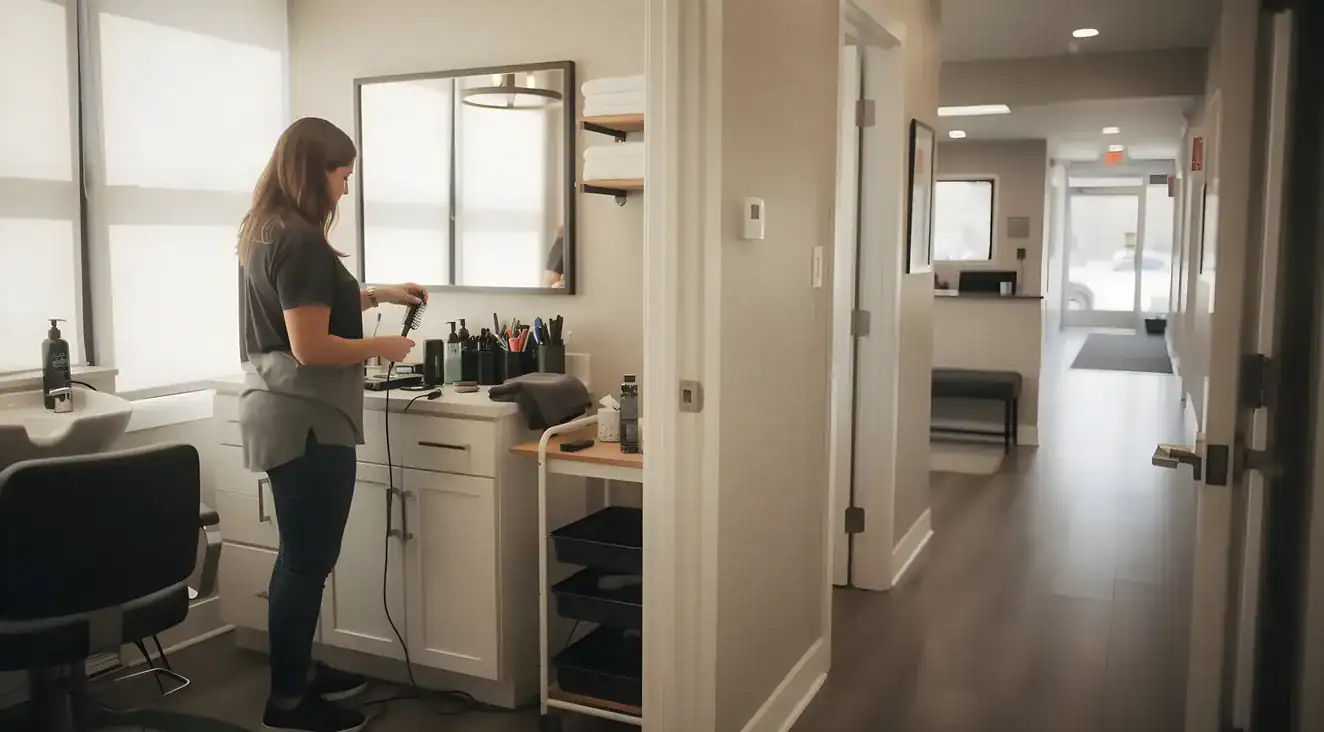
A salon suite rental typically includes the private room, styling chair, shampoo bowl, cabinetry, utilities (electricity, water, and HVAC), high-speed WiFi, 24/7 secure access, and shared common areas like the waiting room, restrooms, and on-site laundry. At an all-inclusive salon suite, one flat weekly rate covers all utilities and building services, so no separate electric or internet bill arrives at the end of the month.
What the rent excludes is the professional layer: your implements, back bar products, retail inventory, professional liability insurance, and booking software. Those remain your expense and your responsibility. This post covers both sides so you know exactly what to expect before you tour.
The term “all-inclusive” has a specific meaning in salon suite rental: one flat weekly or monthly rate covers the private suite and all the building overhead that comes with it. Venus Salon Suites bundles electricity, water, HVAC climate control, and building-wide WiFi into the weekly rate, so renters receive one predictable invoice with no utility accounts in their name. That matters because some facilities advertise a lower base rent and then add utilities separately. The all-inclusive model removes that variability.
At a Glance: What the Weekly Rate Covers vs. What You Supply
Covered by rent
You supply
Specific suite furnishings vary by facility. Confirm the written equipment list in your lease before signing.
Most all-inclusive facilities furnish each suite with:
The flat weekly rate holds regardless of seasonal heating or cooling loads. Building-wide WiFi covers both your professional use and your clients’ connection while they wait.
Building access runs 24/7 via keypad or fob entry. You set your own schedule. If your first appointment is at 6am or your last runs to 9pm, there is no building staff to coordinate with and no posted hours to work around. On-site surface parking is included for both you and your clients, which matters for a client-facing business where parking friction affects retention.
The shared common areas are part of what your rent covers. Your clients have a waiting area before their appointment. Restrooms are shared and maintained by building management. Most facilities provide an on-site washer and dryer for capes, towels, and linens; the machines are a shared amenity, but the towels and capes belong to you. Building security includes cameras and secure entry points. Building management maintains the hallways, restrooms, and waiting area; your individual suite is yours to keep clean.
The all-inclusive model covers the room and the infrastructure. Everything professional is yours to supply. That is the core trade in salon suite rental: flat, predictable rent in exchange for complete control over how you run your independent business. For most beauty professionals transitioning from a commission position, this is the biggest mental shift. You stop getting handed supplies and start owning the full picture.
Texas Renters: Plan for the TDLR Mini-Establishment License
Your personal cosmetology or barber license and this license are two separate documents. The mini-establishment license covers your individual suite space; it is a TDLR requirement before you open for clients.
This is general information, not legal advice. Confirm current requirements with TDLR before applying.
Your professional toolkit comes with you:
The facility provides the room and its built-in plumbing and furniture. You provide the craft and everything required to perform it.
Back bar and retail inventory are both your purchase. “Back bar” refers to the professional products you apply during services: hair color, developer, shampoo, conditioner, skincare actives, massage oils, wax, and any other product that touches the client during the appointment. Retail is the product you sell for home use. These are separate inventory categories, but both are your expense. Back bar products are a direct operating cost and a tax-deductible business expense, separate from your rent line item. If you have been working in a commission salon where the owner orders product and you simply reach for it, managing reorder timing and distributor accounts will be one of the more tangible operational changes.
Linens, towels, and capes belong to you. The building’s washer and dryer handle the cleaning, but you supply them.
Your suite is also a canvas. Signage, artwork, shelving, lighting accents, and retail displays are yours to arrange. Most suite leases allow freestanding and wall-hung decor without special approval. Permanent structural changes (painting walls or installing anchored cabinetry) generally require written permission from building management. Ask before you modify.
On the licensing side, two documents are specific to Texas beauty professionals. First, your state-issued professional license (cosmetology, barber, esthetic, massage therapy, or nail technology) must be current, valid, and displayed in your suite. That is a Texas Department of Licensing and Regulation requirement across all disciplines. Second, and this is the requirement most new suite renters have not encountered before: Texas requires each individual suite renter to hold a TDLR mini-establishment license for their individual suite space. This license is separate from your personal professional license. Venus Salon Suites holds a Texas gallery establishment license for the building under TDLR, which satisfies the facility-level requirement for all tenants. You hold a mini-establishment license for your private suite. The application runs through TDLR.Texas.gov. Factor the processing lead time into your start date planning. This is general information, not legal advice; confirm current requirements directly with TDLR.
Suite lease agreements require each renter to carry professional liability, general liability, and product liability insurance. Most leases also require the facility to be named as an additional insured on the certificate of insurance. The building owner’s property coverage protects the structure and common areas only; it does not extend to your professional activity, your products, or your equipment inside your suite. Rates vary by carrier and coverage level, but proof of coverage is typically a move-in requirement.
With no front desk and no receptionist, you manage all your own appointment booking, client communication, and payment processing. Software platforms built for solo beauty professionals handle scheduling, automated client reminders, and point-of-sale processing in one place. Costs and features vary; choose what fits your workflow and your budget.
Suite renters operate as independent contractors, which means the facility issues a 1099 rather than a W-2, self-employment tax applies at the IRS statutory rate of 15.3% of net income, and quarterly estimated tax payments replace employer withholding. If this is your first time operating as self-employed, a conversation with an accountant before you open is worth the time.
The most significant practical difference between a salon suite and a commission salon is autonomy over your daily schedule. There is no manager to check in with, no front desk to open the building, and no shared schedule to coordinate around. Your keypad or fob grants 24/7 building access, any hour, any day of the year. If you take Mondays off, nobody fills your chair. If your first appointment is at 6am, nobody stops you.
Suite cleaning follows a clear division. Building management handles the hallways, restrooms, and client waiting area. You handle your private suite. The space you rent is your workspace, and keeping it clean is part of what it means to run your own place.
On-site washer and dryer units handle the high-volume laundry generated by capes, towels, and neck strips, so renters avoid off-site laundry costs or commercial laundry service fees. You do the wash when it fits your schedule, and the machines are there when you need them.
One thing new suite renters sometimes underestimate: the licensed professionals in adjacent suites are not your competition. Each person runs their own independent business with a different specialty and a different clientele. Referral relationships develop organically in suite buildings and can become one of the steadier sources of new clients over time.
Suite rental leases are typically simpler than commercial real estate leases, but they still deserve a careful read before you sign. The structure matters as much as the amenities list.
Before You Sign
Lease Review Checklist
Print this or keep it open on your phone during the tour. Each item should have a clear answer in the written lease before you sign.
"All-inclusive" in marketing copy is a signal. The written lease is the document that controls what is actually covered.
Most salon suite facilities bill weekly. A monthly rate, where offered, is roughly 4.3 times the weekly rate. Some renters prefer monthly billing for accounting simplicity; others prefer the weekly cadence because it matches their revenue flow. Ask which billing structures the facility offers before your tour.
Month-to-month agreements are the dominant lease structure in the salon suite industry. You rent on a rolling basis with no long-term commitment, which gives you maximum flexibility while your clientele is building. Some facilities offer a term discount (three or six months paid in advance) in exchange for a lower weekly rate. That arrangement makes sense if your book is already established and you want to lock in your occupancy cost.
Security deposits are typically equivalent to one month’s rent, or two to four weeks of weekly rent, held against damages and unpaid rent. Ask for the return timeline and the deductions process in writing before you sign.
Notice to vacate is typically 30 days written notice. Some facilities have shorter or longer requirements, and the penalty for early termination is a lease clause worth reading closely.
What to confirm in writing before you sign:
The phrase “all-inclusive” in a marketing brochure is a signal, not a lease guarantee. Your rental agreement is the document that controls what is actually covered. If electricity is not listed by name in the lease, it may not be included. Read the written utilities list before you trust the headline.
The standard hair suite (styling chair, shampoo bowl, mirror, and cabinetry) is built around the hairstylist’s workflow. If your discipline is different, there are at least one or two variables to confirm before signing. The suite layout that works well for a hairstylist may require a specific addition for a nail technician or specific floor dimensions for a massage therapist.
Here is what to confirm for each discipline before committing:
| Discipline | What to confirm before signing |
|---|---|
| Hairstylists | Whether a hood dryer is included if you do thermal processing (blowouts, color, treatments) |
| Barbers | Whether the chair is a barber chair with proper recline angle, headrest, and footrest, or a standard styling chair |
| Nail technicians | Whether each workstation has source-capture ventilation (draws fumes from the table surface, separate from room HVAC) and whether a plumbed pedicure station is included |
| Estheticians | Whether the suite includes a facial bed or treatment table and a sink within the suite or immediately adjacent (required for sanitation) |
| Massage therapists | Whether floor space accommodates a full-size massage table (27-30 inches wide, 72-73 inches long) with working room on all four sides |
| Lash, brow, and makeup artists | Whether the suite includes a reclining facial bed or chair and what lighting is installed; LED magnification panels and ring lights are typically renter-supplied |
Specialty equipment belongs in your kit, not the facility’s. Steamers, microdermabrasion units, LED panels, high-frequency devices, nail lamps, and wax warmers are professional tools you bring with you. Confirm whether basic furniture (facial bed, barber chair, pedicure station) is included before assuming it is.
For nail technicians specifically: source-capture ventilation is required under OSHA guidelines and local fire codes for spaces where acrylics, gel systems, or nail dust are present. Confirm in writing whether it is installed at the workstation level. If not, factor the cost and feasibility of a portable unit into your decision.
A tour is the right next step when you have moved past “how does this work” and into “is this the right fit.” The questions below give you a framework for that conversation, whether you are touring one facility or comparing several.
Looking for a salon suite in Lewisville? Call (214) 469-1615 or visit the contact page.
Ask to review the lease before the tour ends, not after. Verify that “all-inclusive” is backed up by a written, itemized utilities list. Ask how the deposit is calculated and what conditions trigger a deduction. Ask what the notice period is and whether early termination terms apply. If your discipline has a specific equipment need (source-capture ventilation, a plumbed pedicure station, a specific chair type, or enough floor space for a full massage table), make it the first thing you verify rather than something you find out after signing.
If you are a Texas beauty professional and this will be your first suite, ask about the TDLR mini-establishment license requirement. A facility that knows the suite industry will already know what it is and be able to walk you through how other renters have handled the application process.
Venus Salon Suites is located in Lewisville at 4770 State Hwy 121 #180, Lewisville, TX 75056. The suites page covers suite details, amenities, and how to schedule a tour. That is the right starting point when you are ready to take a look. The team is available to answer these questions before your visit or during the tour.
Q: What is included in a salon suite rental?
A: A salon suite rental covers the private furnished suite, shared building utilities (electricity, water, and HVAC climate control), high-speed WiFi, 24/7 secure building access, on-site parking, and shared common areas including the client waiting room, restrooms, and laundry facilities. Standard furnished suites include a styling chair, shampoo bowl, cabinetry, and mirror. The renter supplies all professional tools, back bar products, and equipment needed to perform services.
Q: What does all-inclusive salon suite mean?
A: An all-inclusive salon suite charges one flat weekly or monthly rate that covers the private suite and all building overhead: electricity, water, HVAC, and WiFi. There are no separate utility bills to manage, no utility accounts to set up in your name, and no month-to-month cost variability based on seasonal energy use.
Q: What expenses will I have beyond my rent?
A: Beyond rent, an independent beauty professional in a salon suite budgets for professional tools and implements, back bar products, retail inventory (if you sell take-home product), professional liability insurance, booking software and payment processing fees, the TDLR mini-establishment license (Texas renters only), and self-employment taxes at the IRS statutory rate of 15.3% of net self-employment income. Planning for these costs before you sign gives you a realistic picture of your total operating expense.
Q: What documents do I need to rent a salon suite?
A: Plan to provide your current, valid state-issued professional license for your discipline. In Texas, you will also need to apply for a TDLR mini-establishment license for your individual suite space before opening for clients. Most facilities require a certificate of insurance showing professional liability coverage, and some require the facility be named as an additional insured. You will also complete a rental application. Requirements vary by facility and state; this is general guidance, not legal advice.
Q: What are typical lease terms for a salon suite?
A: The most common structure in the salon suite industry is month-to-month with weekly billing, which gives renters flexibility while their client base builds. Notice to vacate is typically 30 days written notice. Some facilities offer term arrangements (prepaying three or six months) in exchange for a discounted weekly rate. Before signing, confirm in writing that all named utilities appear in the lease, the security deposit return timeline is defined, and any early-termination terms are spelled out clearly.
Q: Does the building’s insurance cover me in my suite?
A: No. The building owner’s property insurance covers the structure and the common areas, not your professional liability for services you perform on clients, your product liability, or your equipment. Each suite renter carries their own individual policy. Most suite leases require proof of coverage before you move in; confirm the specific policy types and minimum coverage limits in your lease.